Leave the Rat Race.
Your investment income must exceed your total expenses. Salary is not passive income, and a large cash balance alone does not qualify you.
Passive income > Total expenses
 Philippine Cashflow Club
Before the first roll, get to know the board. Start here, watch a turn unfold, then bring your questions to the table.
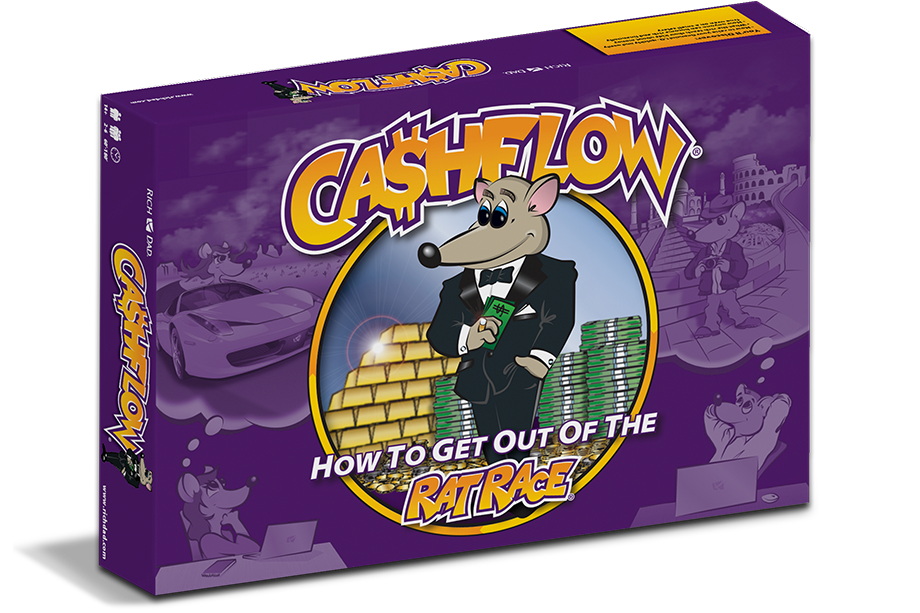
A financial-learning board game by Robert and Kim Kiyosaki. Practice evaluating investments, managing a financial statement, and building income-producing assets inside a simulation.
About the official gameExplore money habits, compare choices, and discuss what happened.
Adults, families, and learning groups, including homeschoolers.
The useful question isn't just “How much cash do I have?” Ask: “What does this choice change on my statement?”
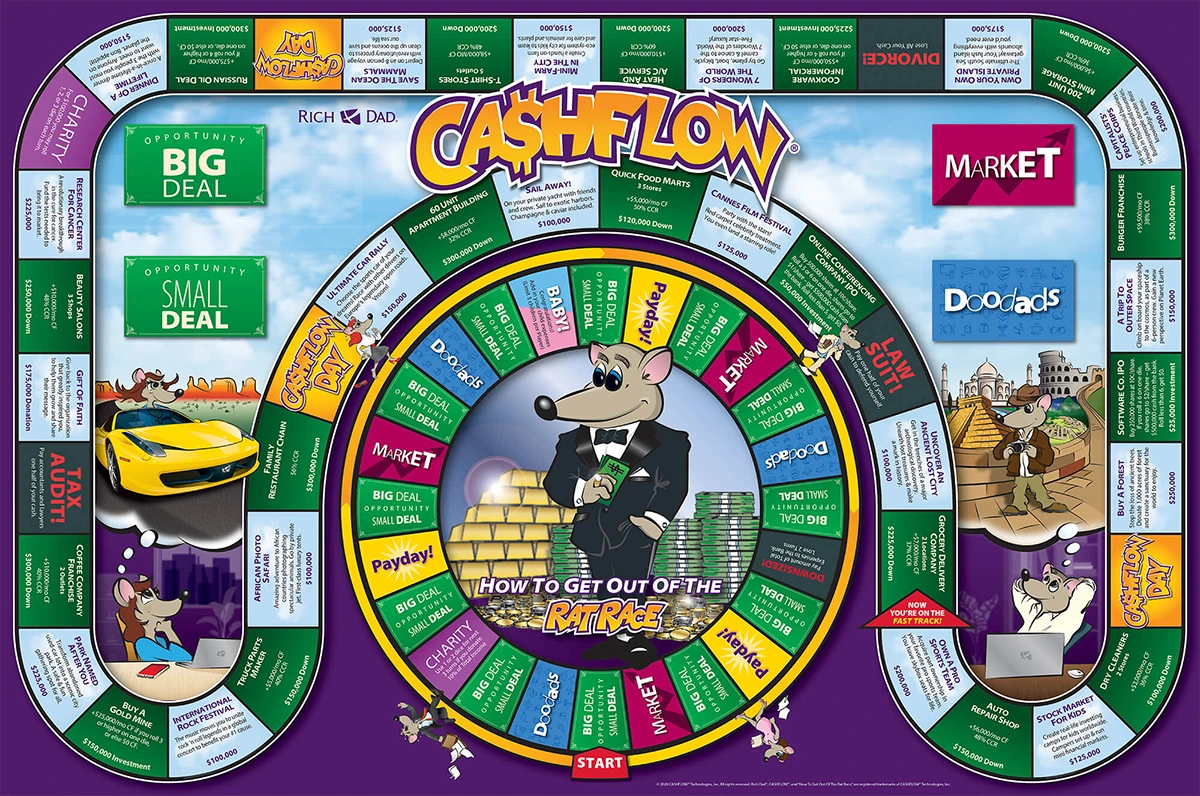
Board, colored pieces, tokens, dice, game money, financial statements, and Profession, Small Deal, Big Deal, Market, and Doodads cards.
Choose a banker. Shuffle and place the four card decks.
Take a Profession card; copy its figures onto your financial statement.
The player to your right checks your calculations.
Collect your monthly cash flow plus savings from the banker.
Pick matching pieces. Mark a Dream; start your rat on the arrow.
Highest die roll starts. Move clockwise; the first green Opportunity is space one.
Use the video alongside the steps. Pause whenever you want to follow along with your own board.
On a normal Rat Race turn, roll one die and move clockwise. Special spaces can change this.
Resolve your space. Read drawn cards aloud, including who may participate. Decide whether to take an optional deal.
Pay or receive game money, then update the affected income, expenses, assets, and debts.
Your auditor checks the figures. Then play passes to the next player.
Space names and some rules vary by edition. For exceptions, use the instructions in your box and ask your facilitator.
Your investment income must exceed your total expenses. Salary is not passive income, and a large cash balance alone does not qualify you.
Follow your edition's winning conditions. In CASHFLOW 101, be first to buy your chosen Dream or add $50,000 in Fast Track cash flow.
Classic winning conditionsMonthly cash flow is total income minus expenses. Your statement separates income from your job and income from investments.
You have a positive monthly cash flow, but you are still in the Rat Race: $400 in passive income is below $2,400 in expenses.
Rich Dad estimates 3–4 hours for beginners. Check your event's published schedule.
The main game is recommended for ages 14+. Ask the organizer about younger participants.
Start with the tutorial and setup steps above. At a club session, ask your facilitator to explain an unfamiliar space before resolving it.
Rich Dad recommends 3–6 for interaction. Our sessions use up to six seats per board; an event can have several tables.
It introduces investing concepts through practice. Game results are not predictions of real returns, and this guide is not personal financial advice.
Rich Dad presents CASHFLOW as a financial-education product. See the official store for current pricing. Buying a board and booking a local session are separate.
Record the bank loan as a liability and its payment as an expense. The official gameplay FAQ specifies a monthly payment of 10% of the bank loan. This is a game rule, not a real-world lending recommendation.
Meet the facilitators or find a published session near you.